
The Best Alternatives to ScholarAI.io (Ranked)
ScholarAI.io has become a commonly referenced tool among students, researchers, and professionals who regularly work with academic material. Its core value proposition is simple: it summarizes scholarly papers so users can understand the main ideas without reading every page in full. For people dealing with dense, technical writing or unfamiliar subject matter, this can feel like a meaningful productivity gain.
In practice, ScholarAI.io is often used as a triage tool. Users upload a paper to decide whether it is relevant, identify the central argument, or get a general sense of the conclusions. In these situations, summarization can be genuinely useful. It reduces the time required to screen sources and lowers the initial barrier to engaging with academic literature.
However, summarization has clear structural limits. By definition, summaries remove detail. They compress arguments, omit reasoning steps, and often exclude methodological nuance. Over time, users may notice that while they can move quickly through material, their understanding remains shallow. Important ideas blur together, and retention drops off sharply once the immediate task is finished.
This becomes more noticeable as academic or professional demands increase. Exam preparation, thesis writing, and long-term research projects require more than surface familiarity. They require the ability to recall information later, connect ideas across sources, and apply concepts in new contexts. At that point, tools built only around summarization start to feel insufficient.
At the same time, the ecosystem of AI-powered research and learning tools has grown more sophisticated. Many platforms now target specific stages of the knowledge workflow: discovery, comparison, synthesis, study, or evidence validation. Instead of asking whether a tool summarizes well, users are increasingly asking whether it helps them actually work with information.
Choosing an alternative to ScholarAI.io therefore depends on what you need the tool to do. Some users need help finding papers. Others need help comparing studies. Some need structured support for learning and retention. The platforms below represent the strongest alternatives currently available, each optimized for a different purpose.
1. Mindgrasp — The Best Overall Alternative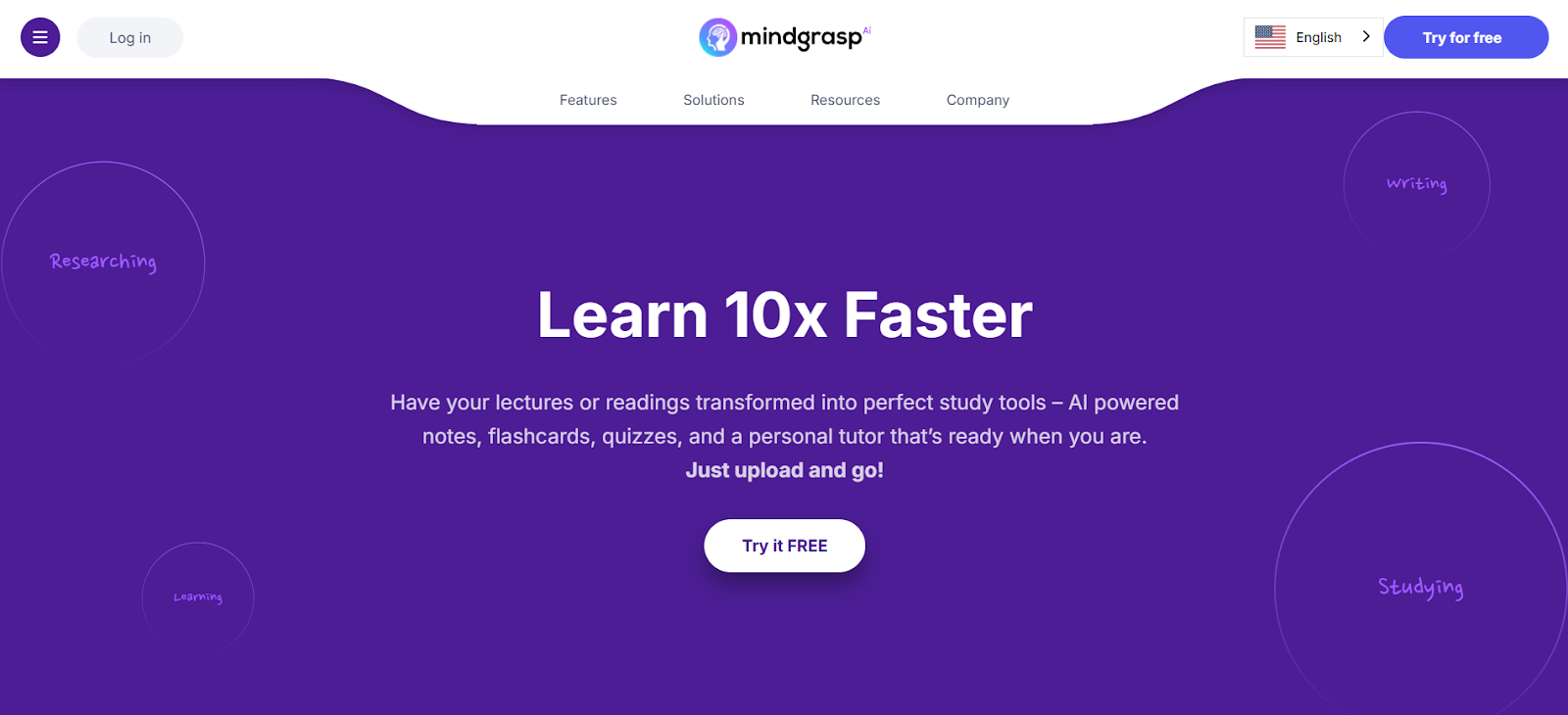
Mindgrasp AI is the strongest overall alternative to ScholarAI.io because it focuses on learning rather than compression. While ScholarAI.io centers on summarizing academic papers, Mindgrasp is built to support the entire process of understanding, studying, and retaining information.
A major difference becomes apparent immediately in the range of supported materials. Mindgrasp is not limited to PDFs or journal articles. Users can upload lecture slides, recorded lectures, videos, articles, and web links, all within the same environment. This reflects how most real academic and professional learning actually happens: across multiple formats rather than a single paper.
Once content is uploaded, Mindgrasp generates structured notes that break material into organized sections. These notes are more detailed than a single summary and are designed for review rather than quick scanning. This makes them easier to return to later, especially when preparing for exams or revisiting a topic after time has passed.
Beyond notes, Mindgrasp generates flashcards and quizzes directly from the material. This shifts the experience from passive consumption to active engagement. Instead of rereading summaries, users are prompted to recall information, answer questions, and identify gaps in understanding. For long-term retention, this approach is significantly more effective than repeated reading.
Mindgrasp also includes an AI tutor that allows users to ask questions about their own materials. This is an important distinction. Rather than generating generic explanations, the tutor responds in the context of what the user has uploaded. Users can ask for clarification, request simpler explanations, or explore related ideas without switching tools or re-uploading content.
Why Mindgrasp works as a replacement
- Supports PDFs, videos, audio recordings, lecture slides, and web content
- Generates structured notes rather than minimal summaries
- Creates flashcards and quizzes that support active recall
- Includes an AI tutor for contextual follow-up questions
- Designed for ongoing study and retention
Who Mindgrasp is best for:
Students, exam preparation, professional learning, and anyone who needs to retain and apply information over time.
Students, exam preparation, professional learning, and anyone who needs to retain and apply information over time.
Who it may not be ideal for:
Users who only want one-sentence summaries or are strictly screening papers at a very high level.
Users who only want one-sentence summaries or are strictly screening papers at a very high level.
Compared to ScholarAI.io, Mindgrasp offers a broader and more practical workflow. It is less about speed alone and more about understanding that holds up over time
2. Elicit — Best for Academic Literature Reviews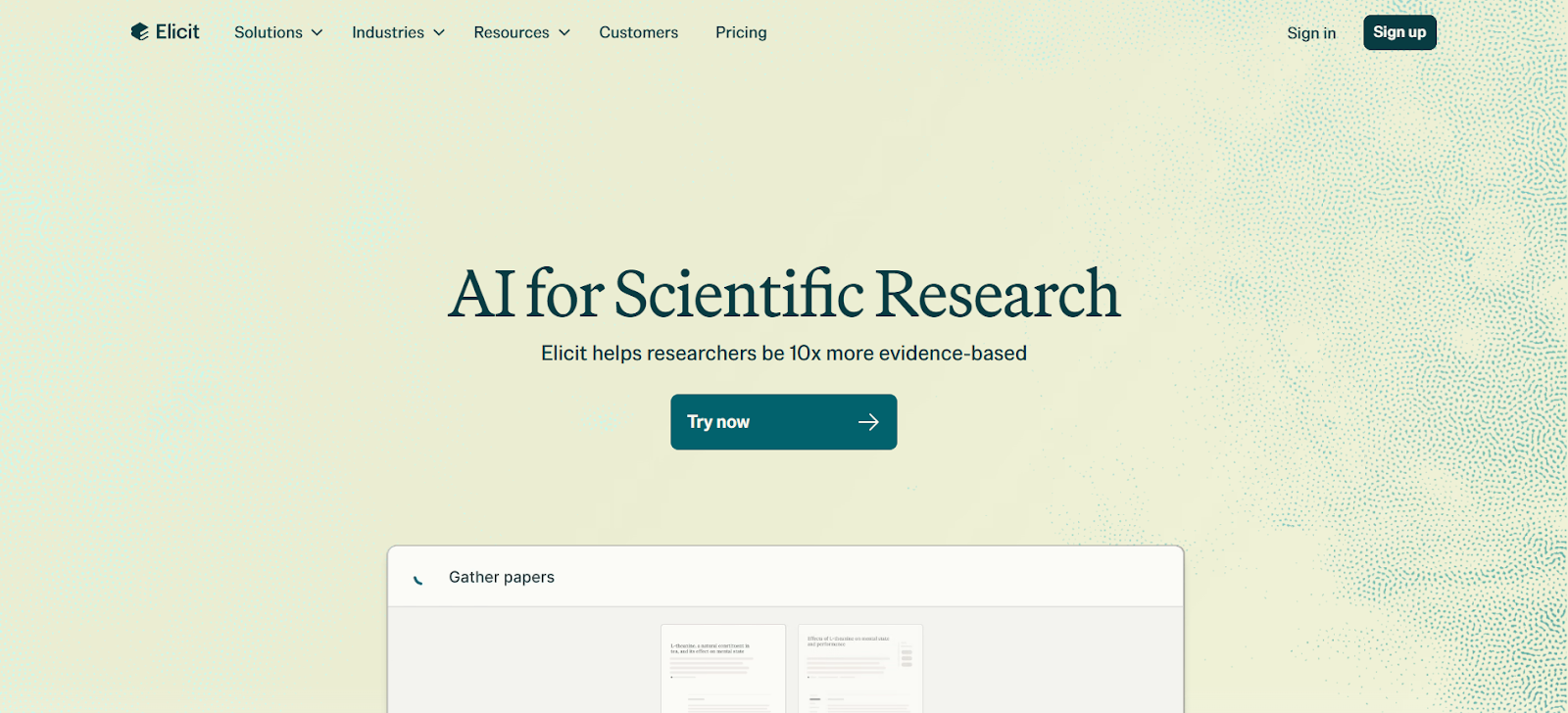
Elicit is designed for a different purpose than Mindgrasp. Rather than focusing on learning or retention, it functions as a research assistant aimed at formal academic work, particularly literature reviews and evidence synthesis.
When users enter a research question, Elicit searches across academic literature and returns studies that are likely to be relevant. What distinguishes Elicit is how it presents information. Instead of long summaries, it extracts structured details such as methodology, sample size, outcome measures, and results. These details are displayed in a way that makes comparison across studies easier.
This structured approach is particularly useful when dealing with large volumes of research. For graduate students, PhD candidates, and researchers working on theses or systematic reviews, Elicit can significantly reduce the time spent skimming abstracts and methods sections.
However, Elicit assumes a fairly high level of subject familiarity. It does not slow down to explain concepts, and it does not provide tools for studying or memorization. If you are learning a topic for the first time, Elicit may feel incomplete on its own.
Where Elicit performs well
- Discovering relevant peer-reviewed studies efficiently
- Extracting methods, results, and limitations in a structured format
- Supporting systematic reviews and academic writing
- Reducing manual comparison work
Who Elicit is best for:
Graduate-level researchers and academics conducting formal literature reviews.
Graduate-level researchers and academics conducting formal literature reviews.
Who it may not be ideal for:
Students studying for exams or users trying to learn a new subject from scratch.
Students studying for exams or users trying to learn a new subject from scratch.
Elicit is often most effective when paired with a learning-focused tool that helps translate research findings into understanding.
3. Semantic Scholar — Best Free Research Discovery Tool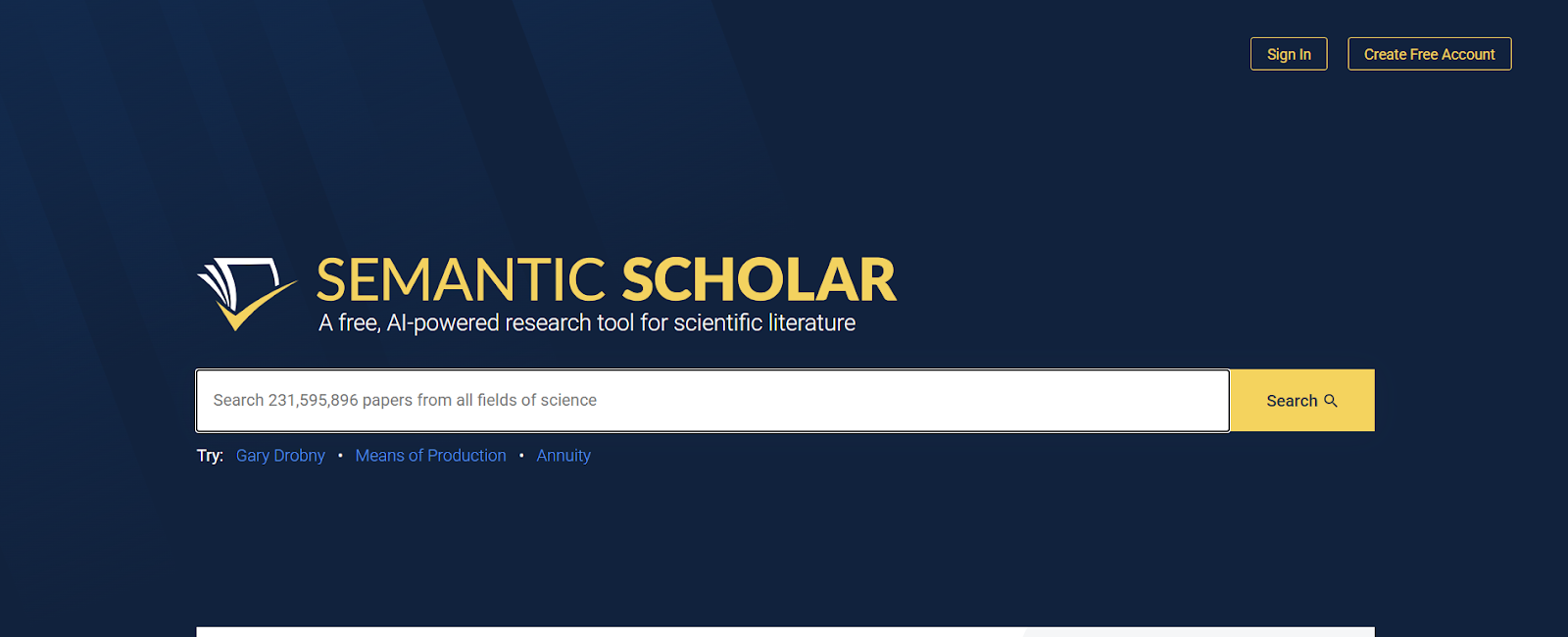
Semantic Scholar is one of the most widely used academic search engines and plays a foundational role in many research workflows. It provides access to a large database of scholarly articles across disciplines and uses AI to surface influential papers and citation relationships.
One of Semantic Scholar’s strengths is its ability to help users understand the structure of a research field. Citation counts, author profiles, and related-paper recommendations make it easier to identify foundational studies and track how ideas have evolved.
Semantic Scholar also provides short AI-generated summaries that help users quickly assess relevance. These summaries are useful for filtering, but they are not intended to replace deeper reading or study.
As a tool, Semantic Scholar is focused on discovery rather than engagement. Once a paper is identified, users typically move elsewhere to work with the content in depth.
Why Semantic Scholar remains widely used
- Free access to a large academic database
- AI-assisted relevance summaries
- Strong citation and author network analysis
- Effective for mapping research landscapes
Who Semantic Scholar is best for:
Anyone searching for academic papers or entering a new research area.
Anyone searching for academic papers or entering a new research area.
Who it may not be ideal for:
Users looking for built-in study, note-taking, or retention tools.
Users looking for built-in study, note-taking, or retention tools.
Semantic Scholar is often the starting point in a workflow rather than the place where learning happens.
4. Perplexity AI — Best for Fast, Cited Answers
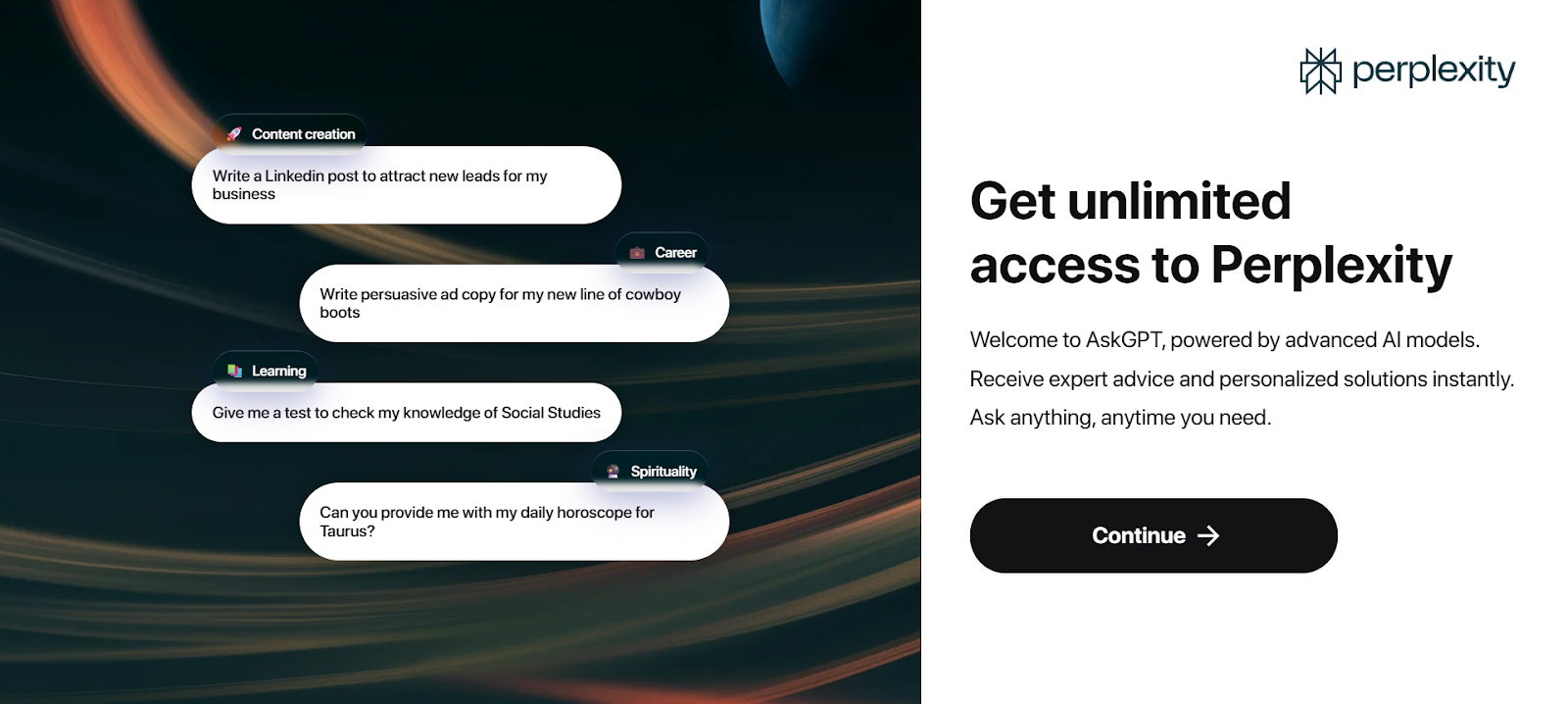
Perplexity AI operates somewhere between a search engine and a research assistant. Instead of returning a list of links, it provides direct answers to questions, supported by citations from academic and reputable web sources.
This format makes Perplexity especially useful for early-stage research and background reading. Users can quickly gain context on a topic without opening multiple papers or navigating complex academic writing.
Perplexity’s conversational interface also lowers the barrier to entry for unfamiliar subjects. It is often used to clarify terminology, explore broad questions, or confirm basic information before diving deeper.
However, Perplexity is optimized for speed and clarity rather than depth. It does not provide tools for structured study, long-term organization, or active recall.
Where Perplexity fits best
- Quick, cited explanations
- Topic exploration and background research
- Clarifying unfamiliar concepts
- Broad coverage across academic and non-academic sources
Who Perplexity is best for:
Users orienting themselves in a new topic or needing fast clarification.
Users orienting themselves in a new topic or needing fast clarification.
Who it may not be ideal for:
Users looking for deep study tools or long-term learning support.
Users looking for deep study tools or long-term learning support.
Perplexity is best viewed as a supplement rather than a standalone solution.
5. Consensus — Best for Evidence-Based Conclusions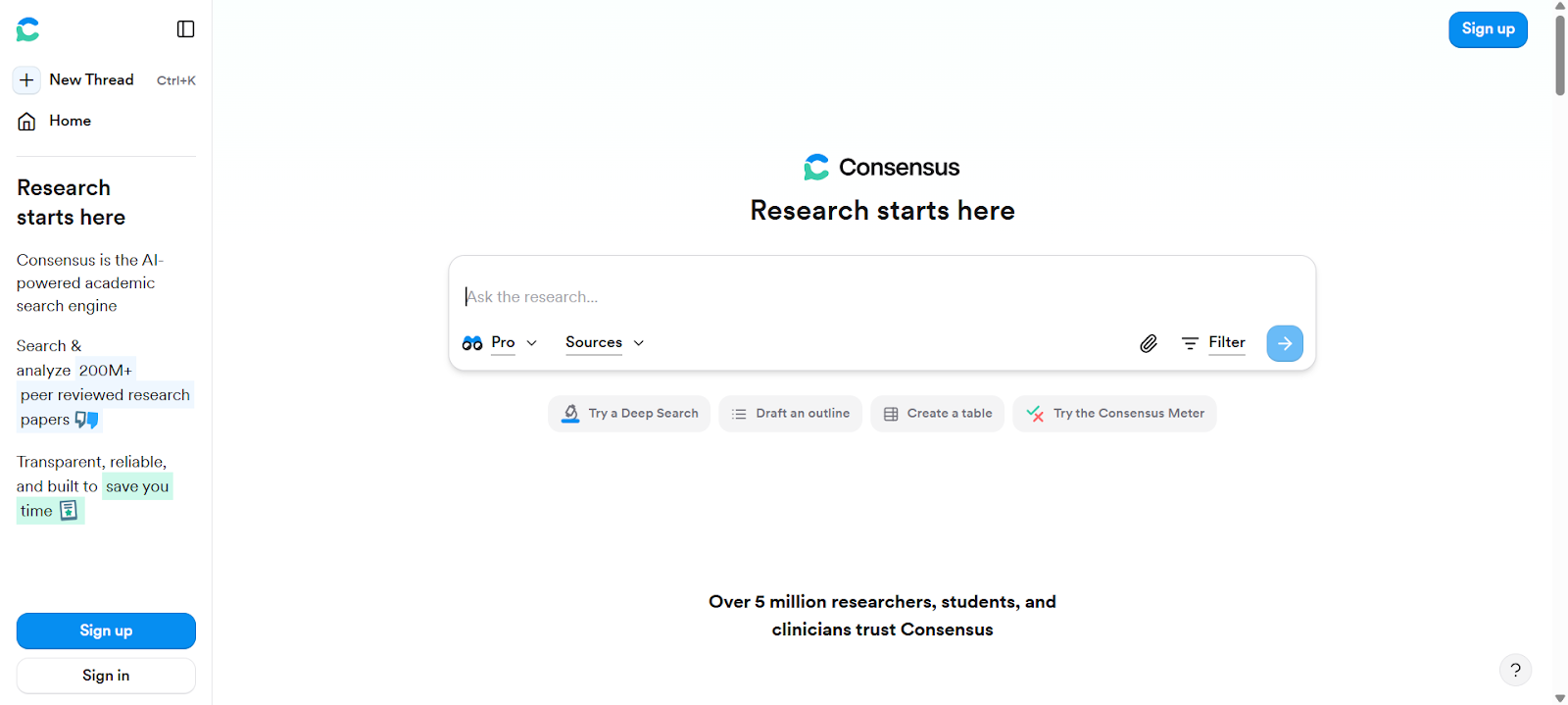
Consensus is designed to answer research questions by synthesizing findings across multiple peer-reviewed studies. Rather than focusing on individual papers, it emphasizes overall agreement within the scientific literature.
This approach is especially useful in evidence-driven fields such as health sciences, psychology, and public policy. Users can quickly determine whether research generally supports a claim or whether findings are mixed.
Consensus is not intended for discovery or learning workflows. It assumes that users already understand the topic and want to check where the evidence stands.
What Consensus focuses on
- Evidence-based answers grounded in peer-reviewed research
- Synthesis of conclusions across multiple studies
- Understanding scientific agreement
Who Consensus is best for:
Users validating claims or checking research consensus.
Users validating claims or checking research consensus.
Who it may not be ideal for:
Users learning a subject or conducting exploratory research.
Users learning a subject or conducting exploratory research.
Consensus works best alongside broader research and learning tools.
Final Takeaway
ScholarAI.io has earned a reputation as a fast and convenient way to summarize academic material. For users who need to quickly identify whether a paper is relevant or extract the main argument, it performs its role adequately. However, the limitations of a summary-only approach become apparent when the goal shifts to actual comprehension, retention, and application of knowledge. Summaries, by their nature, compress information and omit important details, nuances, and reasoning steps. While they save time initially, they do not support long-term learning.
Many of the popular ScholarAI.io alternatives focus on solving specific problems in research or learning workflows. Each performs well in its niche but falls short of providing a comprehensive learning experience:
- Semantic Scholar: Excellent for discovering academic papers and understanding citation networks. Its AI-generated summaries help users quickly assess relevance, but it does not offer structured study tools or mechanisms for retention. Users must take notes separately or switch to another platform to interact with the material in a meaningful way.
- Elicit: Designed for academic research, Elicit allows users to compare studies and extract structured information such as methods, sample sizes, and results. It streamlines literature reviews and systematic comparisons but assumes prior knowledge of the subject. It does not facilitate comprehension for beginners or provide interactive study tools.
- Perplexity AI: Offers quick, cited answers for research questions, making it ideal for early-stage exploration or fact-checking. However, it prioritizes speed and clarity over deep engagement. It lacks features for note-taking, active recall, and long-term retention.
- Consensus: Synthesizes findings across multiple peer-reviewed studies, highlighting overall agreement within the literature. While excellent for checking claims or confirming scientific consensus, it does not support learning workflows, interactive study, or in-depth engagement with material.
How Mindgrasp Stands Apart
Mindgrasp addresses these gaps by focusing on comprehension, interaction, and retention rather than speed or surface-level summaries. Its design reflects how people actually study and process academic material. Unlike other tools, it transforms content into a learning experience rather than just a static summary.
Here are the core ways Mindgrasp outperforms other tools:
- Supports multiple content formats:
Mindgrasp works with PDFs, lecture slides, videos, recorded lectures, and web content in a single environment. This is significant because real-world academic and professional learning rarely occurs in one format. Students often study from a mix of lecture slides, recordings, and articles, and professionals may need to process reports, manuals, and online resources simultaneously. Mindgrasp’s flexibility ensures all these materials can be integrated into one workflow, reducing fragmentation and making it easier to review content comprehensively. - Structured notes for better comprehension:
Instead of providing a single condensed summary, Mindgrasp generates structured notes that break material into logical sections. These notes mimic how people naturally study, grouping related concepts and highlighting important connections. By organizing content in this way, Mindgrasp helps users process complex ideas more effectively than traditional summary tools, which often leave key points disconnected or oversimplified. - Active recall through flashcards and quizzes:
One of the biggest differences between Mindgrasp and other platforms is its focus on active learning. Flashcards and quizzes are automatically generated from the user’s materials, encouraging retrieval practice, which is scientifically proven to improve long-term memory. This transforms study sessions from passive reading into interactive learning, making knowledge more durable and reducing the need for repetitive rereading. - Context-aware AI tutor:
Mindgrasp’s built-in AI tutor allows users to ask follow-up questions directly about their own uploaded materials. Unlike generic AI explanations, these responses are tied specifically to the user’s content, providing clarification, elaboration, or simplified explanations as needed. This feature effectively simulates studying with a knowledgeable assistant, guiding users through complex topics and helping them fill in gaps in understanding. - Designed for long-term retention:
Most tools, including ScholarAI.io, focus on short-term efficiency: summarize quickly, skim fast, move on. Mindgrasp takes the opposite approach by supporting cumulative learning. Its combination of structured notes, flashcards, quizzes, and contextual Q&A encourages repeated engagement, which is essential for mastering dense or technical material. Over time, this leads to stronger understanding and better performance on exams, projects, or professional tasks.
Practical Workflow Examples
Mindgrasp also excels because it fits into real research and learning workflows:
- Exam preparation: A student can upload lecture slides, recorded lectures, and related articles into Mindgrasp. The platform generates notes, flashcards, and quizzes that reinforce key concepts, making review more efficient and retention stronger. Follow-up questions to the AI tutor help clarify concepts that might remain confusing after initial reading.
- Research projects: Graduate students working on theses or dissertations can upload multiple papers. Mindgrasp organizes content, highlights key points, and allows for interactive Q&A. This reduces cognitive overload and keeps research organized in one place.
- Professional learning: Professionals needing to stay up to date with technical reports, manuals, or journal articles can use Mindgrasp to extract actionable insights, organize information, and test understanding without losing time switching between platforms.
Why Mindgrasp Is More Effective Than Other Tools
When compared directly with alternatives:
- Unlike Semantic Scholar, Mindgrasp enables active engagement rather than passive discovery. Semantic Scholar helps you find papers, but Mindgrasp helps you internalize their content.
- Unlike Elicit, Mindgrasp is accessible to beginners. Elicit assumes prior knowledge and does not facilitate comprehension; Mindgrasp breaks down material in ways anyone can understand.
- Unlike Perplexity AI, Mindgrasp supports long-term retention. Perplexity is excellent for fast answers but lacks tools like flashcards or quizzes that encourage repeated practice.
- Unlike Consensus, Mindgrasp is interactive and versatile. Consensus summarizes evidence but does not help users work with, study, or remember it.
In short, Mindgrasp goes beyond mere summarization. It transforms static material into an active learning environment. Users are not just reading or skimming—they are interacting with content, testing themselves, and building understanding that lasts.
Key Takeaways for Users
- Speed vs. retention: ScholarAI.io and other summary-based tools prioritize speed. Mindgrasp balances efficiency with long-term learning.
- Learning vs. discovery: Tools like Semantic Scholar and Elicit are excellent for finding research but do not replace study and comprehension. Mindgrasp combines discovery with interactive learning.
- Single-task vs. multi-purpose: Mindgrasp supports multiple content types and study methods in one platform, reducing the need for multiple disconnected tools.
- Practical results: Over weeks and months of study or research, Mindgrasp users can retain more information, recall it more reliably, and apply it effectively—something summary-only tools cannot achieve.
Conclusion
ScholarAI.io serves a purpose: fast summarization and initial screening. For casual or preliminary research, it is sufficient. However, when deeper understanding, long-term retention, and application of knowledge matter, Mindgrasp clearly outperforms the competition. Its combination of structured notes, interactive quizzes, context-aware AI tutoring, and support for multiple content types makes it the most comprehensive tool for serious learning and research workflows.
For students preparing for exams, professionals digesting complex reports, or researchers analyzing multiple papers, Mindgrasp is not just an alternative—it is a complete replacement that addresses the limitations inherent in summary-based platforms. Its focus on active learning and retention ensures that users are not only processing information faster but also retaining and applying it more effectively.